For a professional truck driver in Ohio, a DOT drug or alcohol violation feels like hitting a brick wall at 65 miles per hour. One moment, you are moving freight down I-71 toward Columbus or navigating the heavy industrial traffic near Toledo; the next, you are parked, your income is frozen, and your future is uncertain.
Whether it was a random test gone wrong, a refusal during a busy schedule, or a mistake during off-duty hours, the result is the same: the Federal Motor Carrier Safety Administration (FMCSA) has placed you in “Prohibited” status. You cannot drive a commercial vehicle for any employer until you complete the Return-to-Duty (RTD) process.
Navigating this federal process can be confusing, especially with the specific pressures of the Ohio job market and the Ohio Bureau of Motor Vehicles (BMV) watching your license status. You might be asking, “What comes next?” or “How long will I be out of work?”
This guide cuts through the confusion. We will break down the Return-to-Duty process into five clear, actionable steps specifically for Ohio drivers. Following this roadmap is the only way to protect your CDL and get back on the road legally.
Step 1: The Violation and Immediate Removal
The process begins the moment a violation is verified. Under 49 CFR Part 40, a violation includes a positive drug test, an alcohol test result of 0.04 or higher, a refusal to test, or an “actual knowledge” violation where an employer witnesses use.
The Immediate Consequence
Safety is the priority. Your employer is federally required to remove you from all safety-sensitive functions immediately. You cannot finish your shift. You cannot drive the truck back to the yard.
- For Employee Drivers: You will be sent home. Many Ohio employers have zero-tolerance policies and may terminate your employment, but you still must complete the SAP process to work for anyone else.
- For Owner-Operators: You must park your truck. You cannot operate under your own authority.
The Clearinghouse & Ohio BMV
Your violation is reported to the FMCSA Clearinghouse. Your status changes to “Prohibited.” Crucially for Ohio drivers, this information is shared with the Ohio BMV. If you delay starting the process, the state may initiate a downgrade of your CDL to a non-commercial license, adding administrative fees and reinstatement hurdles to your list of problems.
Step 2: The SAP Assessment
You cannot return to work without seeing a DOT-qualified Substance Abuse Professional (SAP). This is the gatekeeper of the entire process.
Finding a Qualified SAP
You need a SAP who is certified and qualified under DOT regulations. While you can find providers in major hubs like Cleveland, Cincinnati, or Columbus, drivers in rural Ohio often struggle to find local appointments. Virtual SAP evaluations are permitted and are often the fastest way to get started.
The Initial Evaluation
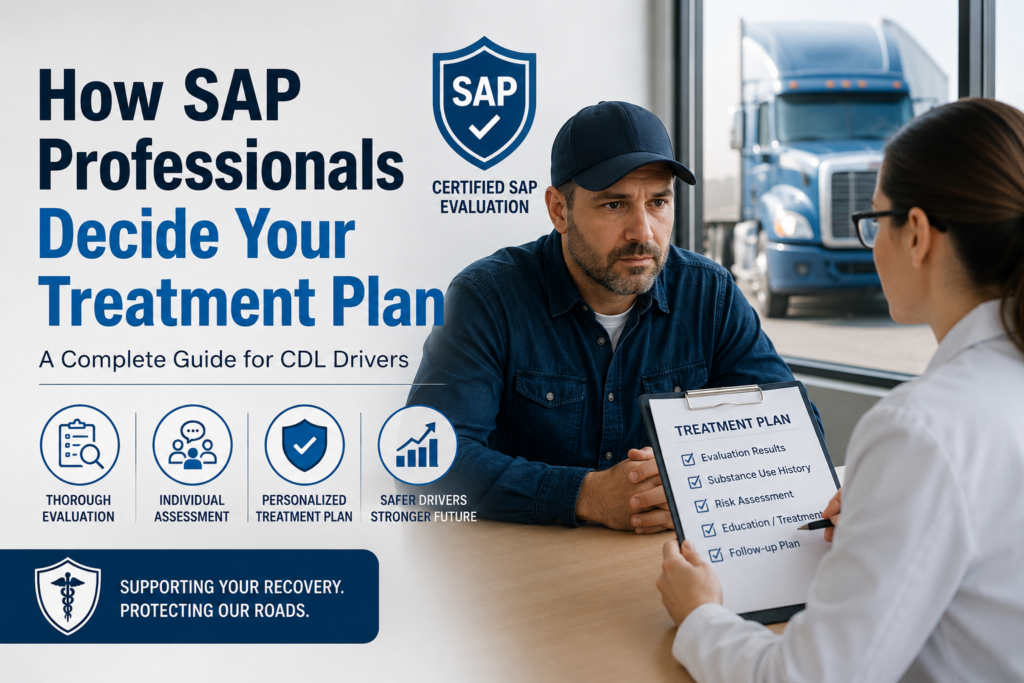
This is a clinical interview. The SAP will assess your history and the circumstances of your violation. Be honest during this meeting. The SAP is not there to judge you, but to evaluate safety risks. Their job is to determine what education or treatment is necessary to ensure you can return to the road safely.
- Note: You must designate your SAP in the Clearinghouse before this meeting can take place.
Step 3: Education and Treatment
After your assessment, the SAP will prescribe a mandatory plan. You cannot negotiate this plan, and you cannot seek a second opinion.
The Spectrum of Care
The recommendation will be tailored to your specific situation.
- Education: For lower-risk situations, this might be a comprehensive drug and alcohol education course.
- Treatment: For more complex cases, this could involve outpatient counseling, group therapy, or an intensive outpatient program (IOP).
Completion is Key
You must complete this program exactly as prescribed. Whether it takes a weekend or several months, you cannot move forward until the provider signs off on your completion. Once finished, you will return to your SAP for a Follow-Up Evaluation. If the SAP determines you have successfully complied with the plan, they will update your Clearinghouse status to “Eligible for Return-to-Duty Testing.”
Step 4: The Return-to-Duty Test
This is the most critical hurdle for getting back on the payroll. Once your SAP marks you as eligible, you are technically allowed to return to work—but only after passing this specific test.
Employer-Driven Process
You cannot order this test yourself. An employer must order it.
- If you are returning to your old job: Your current employer will schedule it.
- If you are looking for a new job: You must find a “second-chance” employer willing to hire you. They will order this test as part of the hiring process.
Direct Observation
The Return-to-Duty test is stricter than a standard pre-employment test. It must be directly observed, meaning a collector of the same gender will watch you provide the sample to ensure no tampering occurs. A negative result on this test changes your Clearinghouse status to “Not Prohibited,” allowing you to legally drive again.
Step 5: Follow-Up Testing
Getting back in the driver’s seat isn’t the end of the process; it’s the beginning of the monitoring phase. To ensure long-term safety, you will be subject to a strict schedule of follow-up testing.
The Schedule
Your SAP will create a follow-up testing plan. By law, this must include a minimum of 6 unannounced tests in the first 12 months of returning to duty. However, the SAP can extend this plan for up to five years depending on your evaluation.
Strict Compliance
These tests are unannounced. Your employer will tell you to report for a test, and you must go immediately—no delays.
- If you are on a run on the Ohio Turnpike or delivering in a remote area, you must stop and test.
- Missing a follow-up test is considered a “Refusal to Test,” which counts as a new violation. This would send you back to Step 1, with even more severe consequences for your career.
Work with a Certified SAP for a Smooth Recovery
The Return-to-Duty process is rigid, but you don’t have to navigate it alone. A single misstep—like missing a document or misunderstanding a timeline—can keep you out of work for weeks longer than necessary.
We specialize in helping Ohio drivers get back to work quickly and compliantly. Our Certified SAPs offer fast, DOT-compliant evaluations with same-day scheduling and virtual appointments statewide. Whether you are in Dayton, Akron, or anywhere in between, we guide you step-by-step from your initial assessment through to your final clearance.
Contact us today to schedule your evaluation and start your journey back to the road.