For a commercial driver in Utah, a Department of Transportation (DOT) drug or alcohol violation can feel like your career has hit a dead end on a remote stretch of I-70. The immediate consequence is a “Prohibited” status in the federal database, which means you are legally barred from driving any commercial vehicle. This federal action then triggers a state-level response: the Utah Driver License Division will disqualify and downgrade your Commercial Driver’s License (CDL).
Suddenly, the license you worked so hard for is gone, replaced by a standard passenger car license. Many drivers feel lost, confused, and believe their career is over. However, there is a defined path back. Reinstating your Utah CDL is a multi-step journey that requires navigating both federal and state requirements. It demands patience, commitment, and a clear understanding of the process. This guide provides a step-by-step roadmap to help you get back on the road legally and safely.
Part 1: Resolving the Federal “Prohibited” Status
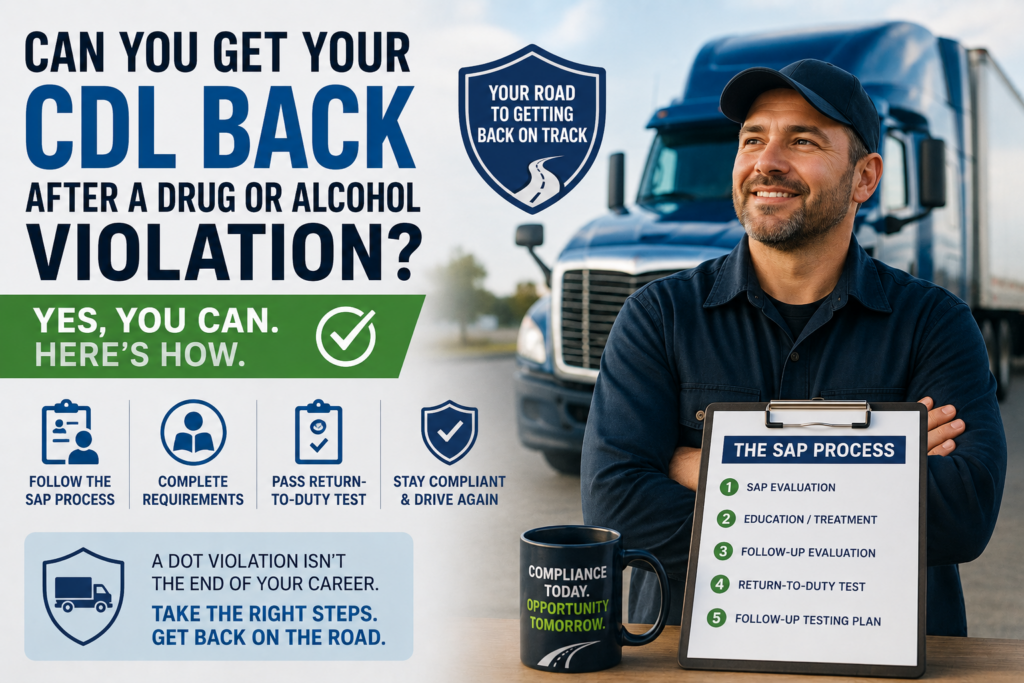
Before you can even think about visiting the Utah Driver License Division (DLD), you must resolve the federal issue. Your “Prohibited” status in the Federal Motor Carrier Safety Administration (FMCSA) Drug & Alcohol Clearinghouse is the primary barrier. The only way to clear it is by successfully completing the federally mandated Return-to-Duty (RTD) process with a Substance Abuse Professional (SAP).
Step 1: Find a Qualified Substance Abuse Professional (SAP)
Your journey begins with a SAP. A SAP is a DOT-qualified professional who acts as the gatekeeper for your return to driving. Your former employer is required to provide you with a list of qualified SAPs. You are responsible for selecting one and scheduling an initial evaluation. In Utah, most SAPs are located along the Wasatch Front, so if you live in a rural area, be prepared to travel for this initial face-to-face meeting.
Step 2: Complete the SAP’s Prescribed Plan
During your evaluation, the SAP will assess your situation and create a personalized plan for education or treatment. This is not optional. The plan could include:
- Attending specific drug and alcohol education courses.
- Participating in an outpatient treatment program.
- Joining self-help groups like Alcoholics Anonymous (AA) or Narcotics Anonymous (NA).
You must complete every requirement of this plan exactly as prescribed. You are almost always responsible for all costs associated with the SAP evaluation and the treatment program, which can be a significant financial burden.
Step 3: Pass the Return-to-Duty (RTD) Test
After you complete the SAP’s plan, you will have a follow-up evaluation. If the SAP determines you are ready to return to safety-sensitive duties, they will authorize you to take an RTD test. This is where many drivers get stuck.
You cannot order an RTD test for yourself. You must have an employer (either your former employer or a new one) order the test for you. This test is always directly observed, meaning a same-gender collector will watch you provide the urine specimen.
Once you pass this test with a negative result, the employer reports it to the Clearinghouse. This action changes your status from “Prohibited” to “Not Prohibited,” clearing you at the federal level.
Part 2: Reinstating Your Utah CDL
With your federal status cleared, you can now address the state-level disqualification. Your CDL has been downgraded by the Utah DLD, and you need to take specific steps to get it back.
Step 1: Gather Your Documentation
Before heading to a DLD office, gather all your necessary paperwork. This includes:
- Proof of your identity and Utah residency.
- Your current, downgraded driver’s license.
- Evidence that you have completed the federal RTD process. You can log into your own FMCSA Clearinghouse account and print a copy of your driver record showing your status is “Not Prohibited.”
Step 2: Visit a Utah Driver License Division Office
You must visit a DLD office in person to begin the reinstatement process. Explain to the examiner that your CDL was downgraded due to a DOT violation and that you have now completed the federal requirements. Present your documentation.
Step 3: Retake Required Tests and Pay Fees
This is a critical step that catches many drivers by surprise. Depending on how long your CDL has been disqualified, the Utah DLD may require you to retake some or all of the CDL examinations. Be prepared for the possibility that you may need to:
- Retake the CDL General Knowledge written test.
- Retake written tests for any endorsements you hold (e.g., Hazmat, Tanker).
- Retake the full three-part CDL skills test (pre-trip inspection, backing maneuvers, and on-road driving).
You will also be required to pay all applicable reinstatement and licensing fees. These fees are separate from any costs related to your SAP program.
Step 4: Manage Your Follow-Up Testing Plan
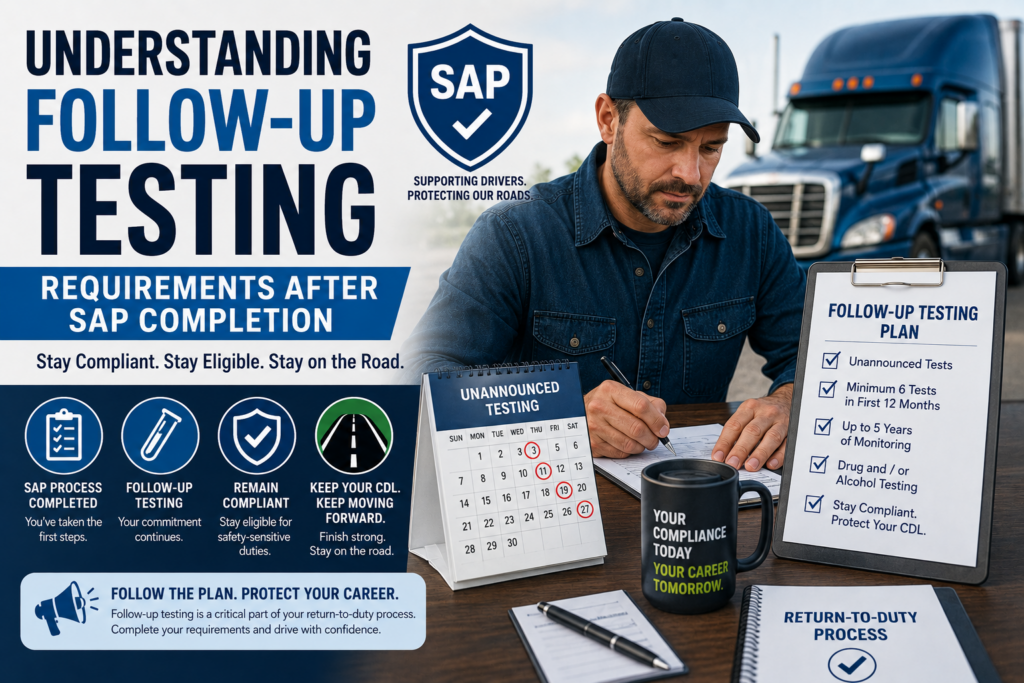
Receiving your new physical CDL is a huge milestone, but your compliance journey is not over. Your SAP prescribed a follow-up testing plan that includes a minimum of six unannounced, directly observed tests in the first year. This plan is now the responsibility of your current employer.
You must adhere to this schedule strictly. If you miss a test or fail one, it is a new violation, and you will be back at square one—your CDL will be disqualified again, and you will have to restart the entire SAP process.
Tips for Navigating the Process Successfully
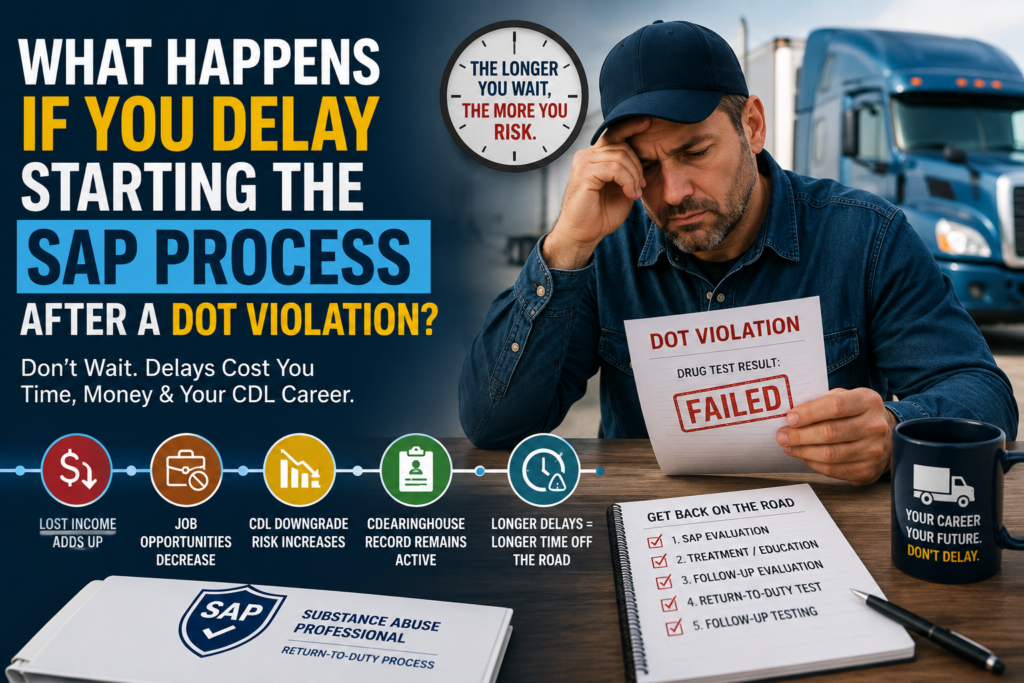
- Don’t Delay: The longer you wait to start the SAP process, the longer your CDL will be disqualified. Take action immediately.
- Be Honest: When looking for a new employer to sponsor your RTD test, be upfront about your situation. They will see your violation in the Clearinghouse anyway. Honesty shows you are taking ownership of the mistake.
- Budget Accordingly: The process is expensive. Between SAP fees, treatment costs, and DLD reinstatement fees, the total can run into thousands of dollars.
- Study for Your Tests: If you are required to retake the CDL exams, study the Utah CDL handbook as if you were a brand-new student. Don’t assume you remember everything.
Reinstating your Utah CDL after a violation is a challenging and humbling process. It requires taking full responsibility for your actions and navigating a complex bureaucracy. However, by following the steps methodically and demonstrating a true commitment to safety, you can regain your license and rebuild a successful career on the open roads of Utah.
Frequently Asked Questions (FAQs)
1. How long will my Utah CDL be disqualified?
Your CDL remains disqualified indefinitely until you complete the federal Return-to-Duty (RTD) process. The timeline depends on how quickly you complete your SAP-prescribed education or treatment plan.
2. Can I get a temporary or hardship CDL while I complete the SAP process?
No. A DOT violation results in a federal “Prohibited” status that cannot be bypassed. There are no occupational or hardship exemptions for a commercial license under these circumstances.
3. Will the Utah DLD automatically know when I complete the RTD process?
No. The Utah DLD and the FMCSA Clearinghouse are separate systems. You must personally go to a DLD office and provide proof that your federal “Prohibited” status has been lifted before they will begin the reinstatement process for your state license.
4. Do I have to pay for the Return-to-Duty test and follow-up tests?
This depends on company policy. The DOT does not regulate who pays. Most employers require the driver to cover all costs associated with their return to duty, including the RTD test and all follow-up tests.
5. What happens if I move to another state while my Utah CDL is disqualified?
The violation is tied to you in the federal Clearinghouse, not to the state. You will not be able to obtain a CDL in any other state until you complete the SAP process and clear your “Prohibited” status. The problem will follow you wherever you go.